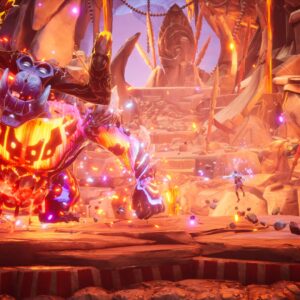
Wakanda didn't just inspire — it gave studios, publishers, and platforms a data point they could point to. The question was no longer whether there was an appetite for African worlds. The question became: who was going to build the games?
Before a single African game studio could point to a global blockbuster as proof of concept, there was Wakanda. When Black Panther arrived in 2018, it did something no game, film, or franchise had done before at that scale: it placed an African visual world at the centre of mainstream popular culture and proved, commercially and creatively, that audiences everywhere would show up for it.
The worldbuilding behind Wakanda was meticulously, seriously African. Production designer Hannah Beachler spent eight months in research and development, compiling a 515-page visual bible detailing the lore, landscapes, and scientific advancements of the fictional nation — drawing on architecture, tribal aesthetics, and cultural traditions from across the continent. The simplest to most advanced concepts in Wakanda carried tribal influence. Beachler used biomimicry as a core design principle — asking what plants and animals could offer, and how those organic logics could be translated into technology and architecture. CBCMotion Picture Association
The costume design went equally deep. Costume designer Ruth Carter built a strict colour palette rooted in Pan-African symbolism — black for royalty, red for the warrior Dora Milaje, green for the river tribe — while sourcing from Tuareg, Himba, Ndebele, and Lesotho traditions. Blankets screen-printed with Adinkra symbols doubled as shields; everything carried layered cultural meaning. Kwasiasare
Before Wakanda was a film, it was a visual idea. And before that visual idea reached Hollywood, African Digital Art was already building the archive that would help make it imaginable.
It is worth pausing to explain what concept art actually is — because it is the invisible foundation of every game, film, and animation you have ever loved. Concept art is the creative development phase that happens before production begins. It is where artists sketch characters, design environments, establish colour palettes, and define the visual logic of a world before a single frame is rendered or a line of code is written. Concept artists are the first people to ask: what does this world look like? What does this character carry in their face, their costume, their silhouette? What does the architecture say about the civilisation that built it? Every visual decision a game or film makes downstream — every environment, every creature, every weapon, every costume — begins in concept art.
African Digital Art recognised early that this discipline was where African creative vision needed to be documented and amplified. Long before Black Panther arrived in cinemas, ADA had been collecting and featuring concept art and character design by African and diaspora artists — work that imagined African characters, mythologies, environments, and futures with specificity and depth. Much of it was labelled Afrofuturist at the time. But it was more than an aesthetic movement. It was a visual knowledge base — a growing body of work that proved African worlds could be rendered at the highest creative level, and that gave future artists both permission and precedent to go further.
That collection lives in the ADA Character Art archive — a growing body of work spanning character design, costume illustration, world-building sketches, and speculative futures drawn from African cultural traditions. Artists working in isolation across the continent and diaspora were, through platforms like ADA, collectively building a visual language that the industry would eventually come looking for.
When Black Panther went into production, ADA was there to document the concept art behind it too. We featured the work of Vance Kovacs — one of the concept artists on the film — whose mechanical and character design concepts for Black Panther, including the mech-armour rhino designs, showed exactly how African visual references were being translated into production-grade concept work at the highest level of the industry. It was proof, published in real time, of what African-inspired concept art looked like when given a billion-dollar platform.
When Black Panther arrived in 2018, it confirmed what ADA’s archive had been quietly arguing for years. Production designer Hannah Beachler spent eight months in research and development, compiling a 515-page visual bible detailing the lore, landscapes, and scientific advancements of the fictional nation — drawing on architecture, tribal aesthetics, and cultural traditions from across the continent. The simplest to most advanced concepts in Wakanda carried tribal influence, with biomimicry as a core design principle — asking what plants and animals could offer, and how organic logics could be translated into technology and architecture.
Costume designer Ruth Carter built a strict colour palette rooted in Pan-African symbolism — black for royalty, red for the warrior Dora Milaje, green for the river tribe — while sourcing from Tuareg, Himba, Ndebele, and Lesotho traditions. Blankets screen-printed with Adinkra symbols doubled as shields; everything carried layered cultural meaning. The sequel, Wakanda Forever, went further still — featuring furniture by Ethiopian designer Jomo Tariku, lighting by Cape Town’s Candice Lawrence, and Djembe tables by Ghanaian studio Tekura, whose managing director called the inclusion “a major recognition for Tekura and African designers to show our excellence to the world.” KwasiasareArtnet News
For the global industry, Black Panther was a revelation. For African digital artists who had been doing this work for years — building African characters, imagining African futures, developing African visual systems — it was confirmation. The creative vocabulary had always existed. What Wakanda did was make it impossible for anyone to pretend otherwise. As Tales of Kenzera creator Abubakar Salim reflected: “If it wasn’t for Black Panther, these stories wouldn’t be told. Because of its success, people are like, ‘oh, there’s a commercial viability here.'” Kotaku
The archive had been built. Now the industry was ready to use it. The question was: who was going to build the games?
Maliyo Games in Lagos made its name by treating the African city itself as a world worth building. From Okada Ride — a game built on the kinetic, barely-controlled rhythm of Lagos motorcycle taxis navigating traffic at full speed — to Iwájú: Rising Chef, developed with Disney Games and Kugali Media, which immerses players in a futuristic Lagos through its cuisine, street energy, and visual culture. As founder Hugo Obi puts it: “The diversity of food, the diversity of languages — once you start to blend those together, you start to create new forms and new styles.” That diversity is not just cultural texture. It is a design system. A colour palette. A grammar for building worlds. The streets of Lagos, rendered with love and specificity, become as rich a game environment as any fantasy kingdom.
African Digtal Art has been documenting creative practice like this long before it reached the scale of studio releases. One of the artists we featured early was Cukia “Sugar” Kimani — a Kenyan-born digital artist and game developer who embodies the journey from concept art to shipped game that this article is really about. As Cukia described discovering games for the first time: “From the moment I put it on and saw the magic on the screen, I knew I had to become one of those magicians making the magic.” That instinct — to move from player to maker, from audience to author — is the same creative impulse driving the entire African game development scene.
Cukia pursued degrees in Computer Science, Mathematics, and Digital Arts, and went on to create games including Boxer, a stripped-back top-down boxing game, and Semblance — a puzzle platformer built on the concept of deformable playdough worlds, where both character and environment could be squished and reshaped to solve puzzles. Semblance became the first game by an African developer ever to launch on a Nintendo console. He later co-founded Nyamakop in Johannesburg alongside Ben Myres — the same studio that would go on to build Relooted, one of the most significant African games of 2025.
That arc — from a Kenyan kid transfixed by a PlayStation screen, to concept artist, to indie developer, to co-founding the studio behind a globally released Africanfuturist game — is not an exception. It is a blueprint.
Perhaps the most talked-about piece of African-rooted visual worldbuilding in recent years is Tales of Kenzera: ZAU, a Metroidvania built entirely on Bantu mythology, architecture, pattern, and colour logic. The creative process behind it is a masterclass in what it means to use African visual knowledge as a design foundation rather than decoration.
Lead artist Ackeem Durrant describes the character design starting point: “The main place we started from when it comes to character design is the Bantu people. Like with the Ndebele tribe, we have a lot of cool colors and shapes. If you look into them they even tie back into buildings — how old is the person that lives there, what’s your status, are you married, how much money do you have. You get all this information just from walking outside someone’s front door.” That depth of cultural reading — where pattern encodes identity, status, and belonging — translated directly into the game’s visual systems, environments, and protagonist design.
The monsters, gods, and character designs drew from the mythologies of the Zulu, Maasai, Tswana, and Ndebele people — stitched together into a world where each biome carries its own emotional logic and visual language. Lead animator Griffin Warner describes the unifying ambition: “The game takes place over a legacy period and an Afrofuture period, so there’s this marriage of old and new through the art, the music, and the effects. Everything we do is trying to bring these together.” ShacknewsDualShockers
One of the most striking visual choices was using vibrant, bright colour to represent death and grief — a deliberate departure from Western conventions, rooted in the fact that in Bantu culture, funerals are celebrations of colour, not darkness. This was not a stylistic decision. It was cultural knowledge applied as design logic — and it produced something players had genuinely never seen before.
Nyamakop’s Relooted constructs an entire Africanfuturist near-future with Johannesburg as its anchor. CEO Ben Myres describes the creative intention plainly: “We wanted to build something that feels unmistakably African, while meeting the technical and narrative standards of the world’s best games. This is about showing what’s possible when African stories are given world-class platforms.” IT-Online
The game’s character design is itself a continent-wide act of representation: a crew of specialists drawn from Lesotho, Zambia, Zimbabwe, Ghana, Nigeria, Ethiopia, and Tanzania, each with their own visual language and cultural grounding. The artifacts players recover are real — researched from documentary sources and recreated with painstaking craft, each one becoming both a gameplay object and an education in African art history once reclaimed. African artists contributed directly to character modelling, texturing, and production-ready topology throughout development.
Kenya’s game scene is being built with as much creative intention as it is technical ambition. Mwaura Kirore — award-winning illustrator, concept artist, and creative director — is one of its defining figures. Known for his striking black-and-white character art, Kirore co-founded Planet Rackus and created Ma3 Racer, inspired by Nairobi’s matatu culture. The game hit one million downloads globally within its first year. Now, through Dung Beetle Studios, his upcoming title Mashujaa: Return of the Legends is set to reimagine African heroes for a new generation of players, blending
Jiwe Studios is building the ecosystem around that creative energy. Their game Umoja wove together 25 community-led stories from the Swahili Coast into an interactive world, making ancestral narratives the creative foundation of a digital experience. Their 2025 game jams brought together developers, artists, and storytellers across Nairobi, Ghana, Senegal, and South Africa — with African folklore, AI-driven gameplay, and audio-driven storytelling as core themes, and prizes, incubation, and publishing pathways attached
The game development pipeline is, at its core, a creative art pipeline. Before a single line of code is written, concept artists sketch characters and environments. 3D modellers sculpt worlds. Texture artists bring surfaces to life. Animators give characters movement and personality. Narrative designers shape how players experience everything.
Every one of these roles is one African digital artists are already trained for — through illustration, animation, 3D art, graphic design, and digital storytelling. The skills transfer directly. What the African games industry is now providing is context and demand: worlds that need to be built from African visual knowledge, because only people with that knowledge can build them with authenticity and depth.
As Prosper Moses, self-taught 3D artist and founder of Lagos-based CodeBox Games, puts it: “I began to notice how underrepresented African culture is in gaming. That realization pushed me to take a step further — to create bold, culturally authentic games that showcase African stories, traditions, and mythology on a global stage.” IsaKaba
Black Panther proved the appetite. The studios are building the worlds. The invitation, now, is for African digital artists — illustrators, concept artists, environment designers, character modellers, animators, and visual storytellers — to step fully into an industry that not only needs them, but cannot tell these stories without them.
The world is the game. African artists have always known how to build it.