


Collage has never been a neutral act. From the moment an image is cut free from its original context and placed beside another, a claim is being made — about what belongs together, about whose stories share a frame, about who gets to reconstruct the world. For African artists working digitally today, that claim is urgent and deliberate. The colonial photograph, the ethnographic catalogue, the fashion editorial that never included your face, the historical archive that recorded your civilisation as footnote or absence — these images exist. African digital collagists are taking hold of them, cutting them apart, and insisting on something different.
Over seventeen years of documentation, African Digital Art has tracked the emergence of a distinct visual movement: artists across the continent and its diaspora using digital collage not as aesthetic exercise but as a practice of reclamation, healing, and resistance. Their approaches differ — in geography, in method, in what they are reaching for — but the underlying logic is shared. The fragment is not failure. The layer is not confusion. To assemble is to argue.
The Archive as Raw Material

The colonial archive was never neutral. Photographs were staged. Records were selective. The figures who built, farmed, prayed, raised children, and governed communities across Africa were rendered in ways that served external purposes — anthropological curiosity, administrative control, the aesthetics of exoticism. The archive remembered what power wanted remembered.
African digital collage intervenes directly in this problem. Its artists take the archive — colonial imagery, vintage portraiture, press photographs, mass-produced print media — and feed it back through their own hands, stripping images of their original framing and repositioning them around Black subjectivity. The gaze is cut out. The figure is set free to mean something else.
Nowhere is this more literally enacted than in the practice of Thato Toeba, a Lesotho-born artist, lawyer, and researcher working from Maseru. Their layered photomontages draw on historical records, colonial photography, and mass-produced print media to interrogate who gets remembered and who gets erased — by the law, the church, the state. Toeba also founded the Lesotho Archives, an open-source platform dedicated to preserving and questioning the narratives that shape the nation’s identity. The impulse is both curatorial and combative. As Toeba has put it: “Just because a person is not present in the archives of their country, that doesn’t mean they weren’t present in the place’s history.”
That sentence is a collage manifesto. Toeba’s practice — recognised with the 2025 FNB Art Prize — works by uprooting images from their authorised contexts to propose, in their own words, “alternate realities through reconstruction of hallucinated images.” The photomontage becomes a counter-document: evidence of what the official record refused to hold.
The Self as Site

Puleng Mongale, born in Soweto and based in South Africa, came to collage through photography and styling, and describes herself as self-taught: “I didn’t have other voices competing with my own, so I was able to create from my imagination.” Her practice centres digital self-portraiture across time — bringing past and present versions of herself into the same frame, layering who she was with who she is becoming. “These collages remind me how far I’ve come in my journey of survival and healing,” she has written. “I am changed and imperfect, yet my agency remains central.”
The layering is literal and conceptual simultaneously. Mongale digs into her personal archive — old photographs, memories, images of the women who raised her — and reassembles them alongside her present self. “Collages would allow me to mix the old with the new,” she explains. “They would allow me to reinvent images and give them new contexts.” The result is a form of visual reckoning that refuses to perform trauma while not erasing it either. As she puts it: “This work is not concerned with the performance of pain. It is about the practice of allowing myself to exist.”
African digital collage intervenes directly in this problem. Its artists take the archive — colonial imagery, vintage portraiture, press photographs, mass-produced print media — and feed it back through their own hands, stripping images of their original framing and repositioning them around Black subjectivity. The gaze is cut out. The figure is set free to mean something else.

Nkiruka Oparah, a Nigerian-born, Oakland-based artist, extends this logic of self-portraiture into a meditation on diasporic identity. Working across installation, collage, experimental printmaking, looping gifs, and assemblage, Oparah deconstructs their own image to portray “the self as an evolving, layered entity rather than a static construct.” The collage form is perfectly matched to this argument: the diaspora self is always in translation, always assembled across multiple origins and inheritances. Oparah’s work doesn’t resolve that complexity into a clean image. It holds it in visible tension.
Identity, Spirituality, and the Speculative Present

Not all African digital collage reaches backward into history or inward into self. Some of the most compelling work in the tradition builds sideways — into a parallel present where African aesthetics, spiritualities, and bodies coexist with contemporary digital vocabularies on their own terms.
Alexis Chivir-ter Tsegba — whose practice spans digital collage, illustration, video, and installation — occupies precisely this speculative territory. Her compositions layer African bodies, spiritual iconography, and dreamlike landscapes into visual narratives that “interrogate boundaries and blend media seamlessly.” Themes of queerness, gender expression, spirituality, and Afrofuturism recur throughout her work, producing collages that are at once intimate and expansive. The political act here is representational: insisting on the presence of bodies and identities that mainstream visual culture has consistently excluded or distorted.
Souad Iris, a Senegalese, Swiss and French artist, builds this speculative present through the self-portrait as cultural meeting point. Her collages blend textures, colours, and visual elements from Senegal and West Africa with the formal possibilities of digital composition, creating images that hold multiple inheritances simultaneously in a single frame. She has described art as “a vector of change, a way to offer a different reality” — and in her collages, the layering of cultural signs is the mechanism through which that different reality is proposed. “In its ultimate form,” she writes, “art should transcend the boundaries of actual society and come up with a utopia, which our world currently truly lacks.”
Carlos Fama, a Spanish artist with a deep investment in African visual culture, represents a different position within this movement: the cross-cultural collagist who uses the form as cultural mediation. His high-contrast portraits of Black women layer African textiles, symbols, and visual traditions with graphic design precision, creating images that celebrate Black femininity while challenging the question of who gets to construct and reframe African aesthetics. His presence in this tradition raises a productive tension the form itself invites: collage, which has always assembled across origins, attracts artists who are themselves assembled across cultures.
Memory, AI, and the Expanding Toolkit
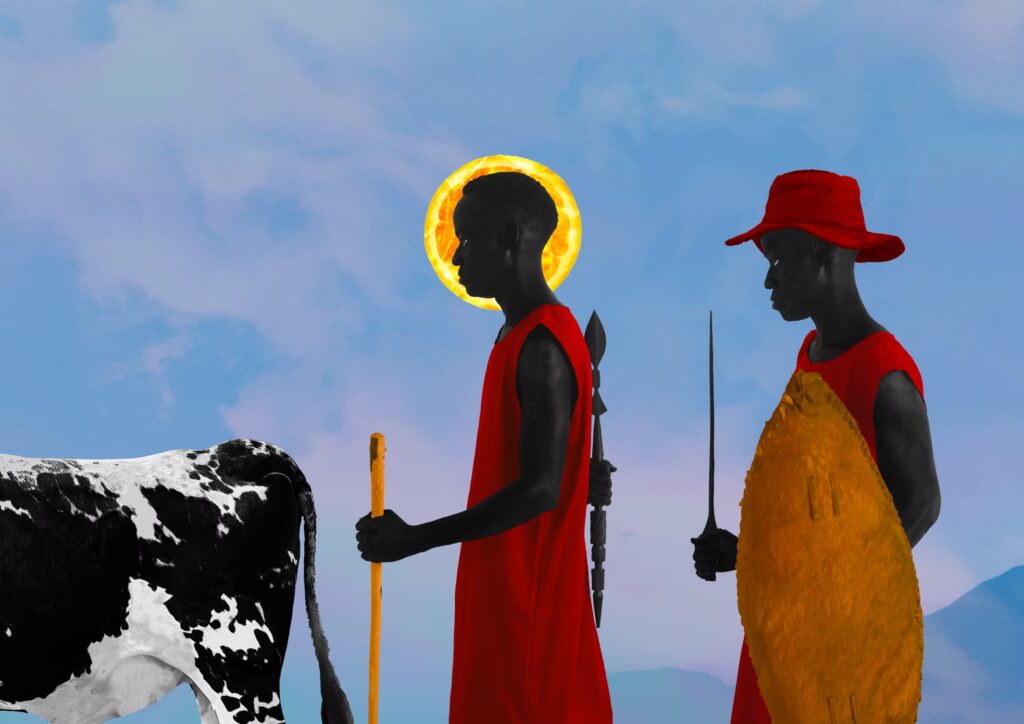
The digital collagist’s toolkit is not fixed. Evans Akanyijuka, working across Uganda and beyond, has pushed the form into territory that earlier collagists could not have imagined: the collaboration between human intuition and machine intelligence. His practice moves from photography and analogue collage into AI-driven image generation, treating generative AI not as a tool of efficiency but as a creative partner — what he describes as “a shared dreaming process.” His compositions appear “fragmented yet intentional, mirroring the ways identity is constructed — through partial histories, layered influences, and shifting interpretations.”
The fundamental logic, however, is unchanged. Whether the scissors are physical, digital, or algorithmic, the act is the same: taking hold of images that exist in the world and insisting on new relationships between them. Akanyijuka builds “visual archives that resist fixed narratives” — and in doing so, extends the collage tradition into its next form.
Why Collage and Why Now

It is worth asking why collage keeps returning as the medium through which African artists address history, identity, and resistance. The answer is structural.
Painting proposes a unified surface. Sculpture proposes a continuous object. Collage proposes a relationship between fragments — and insists that this relationship is constructed, contingent, and therefore open to reconstruction. For artists working within histories of fragmentation — colonialism, the diaspora, apartheid, systematic erasure from the archive — this is not an aesthetic preference but an epistemological position. The world as they have inherited it is already discontinuous. The question is who controls the terms of assembly.
African digital collagists are answering that question from Maseru and Soweto, from Oakland and Nairobi, from Lagos and Dakar. What distinguishes their practice from the long history of collage in Western modernism is not the gesture of cutting but the relationship to the archive being cut. Where Dada disrupted a culture of images it was also native to, these artists are working with materials from which their subjects were systematically excluded — or included only on others’ terms. The digital environment extends this reach while keeping the fundamental logic intact: taking hold of images that exist in the world and insisting on new relationships between them.
Akanyijuka’s project of building visual archives that resist fixed narratives is, in this sense, less a formal innovation than a continuation — the collage tradition extended into the conditions that now shape how images are stored, circulated, and controlled. The screen changes the surface. It does not change what is at stake in deciding what belongs together.
Explore the full collage collection at africandigitalart.com/collections/collections/collage and the artists shaping this tradition at africandigitalart.com/tag/african-digital-collage.
COLLAGE
COLLECTION

The Cut and the Claim: African Digital Collage and the Art of Resistance
- 22275 Views
- 11 Min


Ngadi Smart Sierra Leonean Visual Artist & Illustrator
- 20449 Views
- 4 Min
EDITORIAL
COLLECTION



African Digital Art is an independent archive and platform documenting digital creativity, culture, and innovation across Africa and the diaspora. For 17+ years, we’ve highlighted artists, designers, animators, photographers, game developers, and creative technologists shaping the future of African digital culture. Your support helps us continue publishing stories, preserving creative histories, researching emerging movements, and creating visibility for African creatives around the world. If this platform has inspired you, introduced you to new artists, or helped you feel connected to African creative culture, consider supporting the archive. Every contribution helps sustain independent storytelling and keep this growing cultural archive accessible for future generations.


