Across photography, film, painting, sculpture, sound and archives, Kudzanai Chiurai has spent two decades examining what remains after independence: the violence that survives political transitions, the psychological weight of displacement, and the images through which African societies remember themselves.
Born in Harare in 1981, one year after Zimbabwe gained independence from Britain, Chiurai has developed a practice that refuses the neat division between artist, filmmaker, photographer, archivist and cultural activist. His work moves between photography, painting, drawing, sculpture, installation, film, publishing, music and sound, constructing an expansive visual language through which to examine political and social life in Southern Africa.
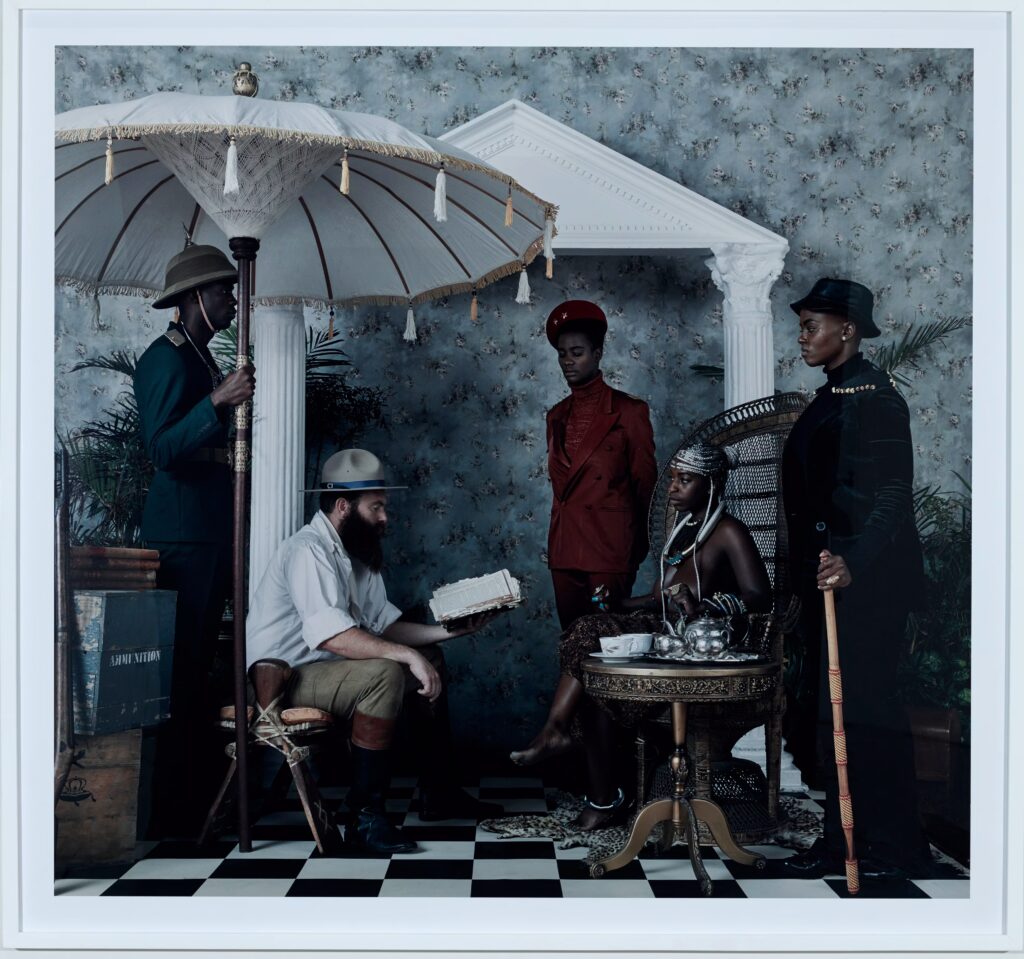
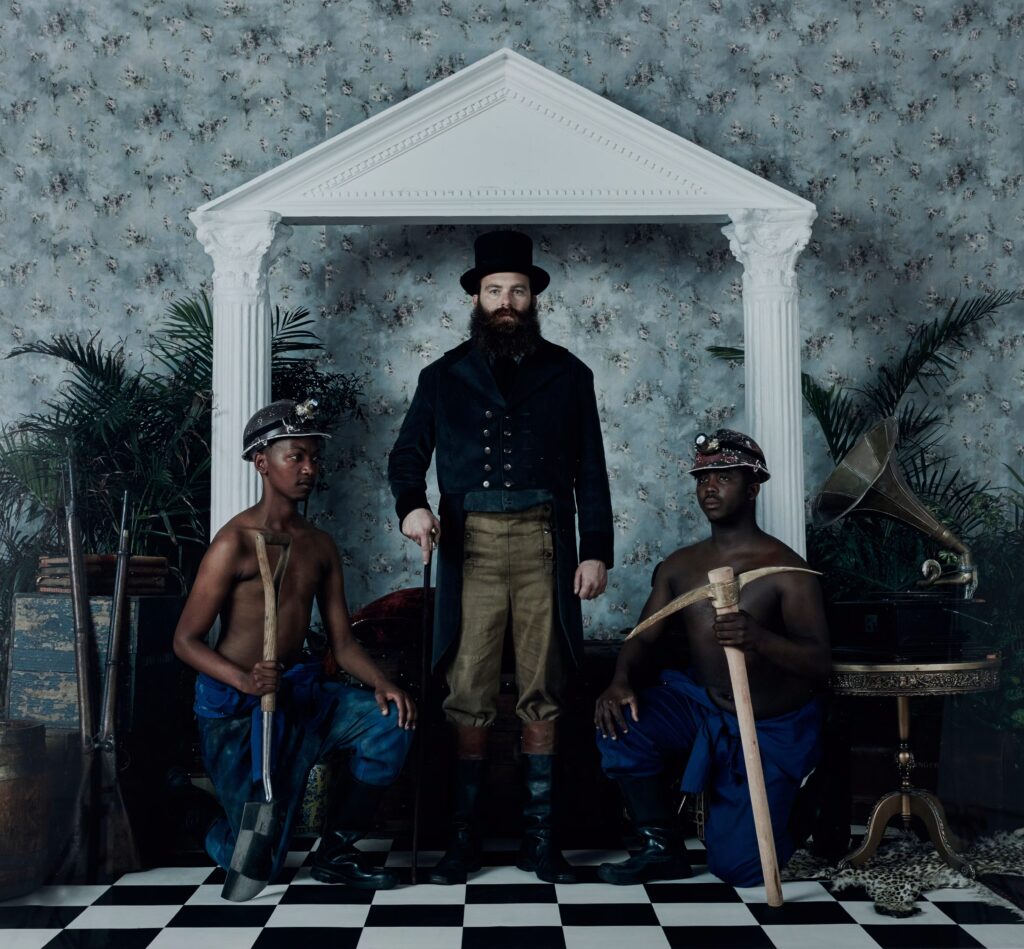
There is something deliberately theatrical about a Kudzanai Chiurai image. Figures appear dressed as politicians, soldiers, prophets, celebrities or ghosts. They inhabit rooms that feel simultaneously historical and contemporary. Religious iconography collides with popular culture; colonial documents meet fashion imagery; political uniforms sit alongside extravagant costumes. Nothing is entirely stable. The past leaks into the present, while the present seems already haunted by futures that have failed to arrive.
At the centre of that language is a persistent question: what happens to a society after the official story of liberation has been written? His work traces the continuities between colonialism and the postcolonial state, between liberation and authoritarianism, between migration and exile, between economic aspiration and inequality. Rather than treating history as something safely contained in museums and textbooks, he brings it into the image as something unfinished, contradictory and alive.
The deeper significance of Chiurai’s practice lies in his insistence that African history must be read through its images, sounds, objects and memories — and that these materials belong to the present as much as to the past.
Chiurai’s practice emerged from a particular historical moment: Zimbabwe at the beginning of the twenty-first century, when the promises and contradictions of post-independence politics had become increasingly visible.
His relationship to politics has never been abstract. In 2008, amid Zimbabwe’s political crisis, Chiurai created murals and posters critical of the government. The work brought him into direct conflict with the political environment around him, eventually contributing to his decision to live in exile in South Africa. He went on to complete a BA in Fine Arts at the University of Pretoria in 2005 and spent several years living and working in South Africa.
That experience of displacement became inseparable from his artistic vocabulary.
Rather than documenting political events in a conventional journalistic manner, Chiurai began constructing elaborate visual worlds. His images borrow from propaganda, advertising, cinema, fashion photography, religious painting and political iconography. They often look spectacular before their darker implications become apparent.
This is part of what makes his work so compelling.
The photograph becomes a stage, and the stage becomes a political arena.
His figures are rarely passive subjects. They perform power. They wear it, parody it, inherit it and sometimes destroy it. The elaborate costumes and theatrical environments reveal how political authority is itself a form of performance — sustained through symbols, uniforms, ceremonies, images and narratives.
Chiurai’s recurring character B-Diamond is one of the clearest examples. Presented through extravagant clothing, ceremonial chains and political regalia, the figure embodies a form of corrupt postcolonial authority. At the 2024 Venice Biennale, Chiurai’s work used B-Diamond alongside colonial maps, barbed wire, land-surveying instruments and archival references to examine the continuing structures of extraction, displacement and political power.
The work asks an uncomfortable question:
How much of the colonial state survives inside the postcolonial imagination?
Kudzanai Chiurai’s work begins with a question that has followed the postcolonial African state for generations: what happens after independence?
Not the ceremonial moment of independence, nor the flags, speeches and celebrations that accompany the birth of a nation, but what comes afterwards—the difficult decades in which colonial structures persist, political liberation becomes institutional power, economies remain uneven, histories become contested and societies attempt to imagine futures beyond the systems that shaped them.
Perhaps the most radical evolution of Chiurai’s practice is his decision to stop making history only through images and begin collecting it through objects.
The Library of Things We Forgot to Remember, begun in 2017, is an evolving archive of Southern African cultural and political memory. Its materials include vinyl records, posters, paintings, publications and other objects drawn from private African collections. Each iteration invites a different librarian to examine the collection and curate an exhibition from it.
The library contains Zimbabwean Chimurenga music, South African anti-apartheid recordings and speeches by figures including Kwame Nkrumah, Ian Smith and Martin Luther King Jr.
It is an archive, but not a conventional one.
There is no suggestion that history can be neatly classified.
Instead, Chiurai allows different objects, voices and political movements to exist beside one another. Music becomes historical evidence. Posters become political documents. Vinyl becomes memory. Private collections become alternative institutions.
The library asks us to consider what official archives leave behind.
Or rather, what they leave out.
The title itself is an argument against cultural amnesia.
What have we forgotten?
Who decided that it was forgettable?
Which songs survived?
Which political ideas disappeared?
Which objects were preserved in private homes because institutions did not consider them worthy of collecting?
And what happens when these things are brought together again?
Chiurai describes the materials in the archive as “broadcasts of Afro-futures”—signals from earlier liberation movements that continue to speak into the present.
This is where the archive becomes more than preservation.
It becomes a technology for imagining.
The Library of Things We Forgot to Remember suggests that the future cannot be built solely by looking forward. It also requires recovering ideas, relationships and cultural forms that were interrupted, suppressed or forgotten.
At Malmö Konsthall, where the library was presented as part of FLIGHT, the archive was described as an audio-visual collection of Black resistance, solidarity and collaboration, with its vinyl collection connecting Zimbabwean Chimurenga music to South African anti-apartheid struggle.
The project therefore extends Chiurai’s long-standing interest in representation into the question of knowledge itself.
Who owns history?
Who gets to archive it?
Who decides how it is displayed?
And can an archive be both a record of the past and a tool for producing another future?
Taken together, Kudzanai Chiurai’s practice is an expansive investigation into how people and societies construct meaning in the aftermath of political and social upheaval. Across photography, film, painting, sculpture, sound, fashion, publishing and collecting, he examines the relationships between power and representation, migration and belonging, masculinity and authority, while questioning the narratives and systems that shape contemporary African life.
What makes the work distinctive is the way Chiurai moves between mediums without treating them as separate territories. His photographs operate with the visual language of cinema and theatre, bringing together fashion, religious symbolism, political imagery and art-historical references. His films introduce movement and sound into these constructed worlds, while his installations and archival projects give physical form to ideas about memory, identity and cultural inheritance. The result is a practice in which image-making becomes a way of examining how power is performed, remembered and reproduced.
His idea of the “colonial future” offers a particularly useful way into this practice. Rather than positioning colonialism as a closed chapter, Chiurai considers how its structures and assumptions continue to influence contemporary political, economic and cultural life. His work responds by disrupting familiar visual codes—recasting political figures as theatrical archetypes, transforming religious and European art-historical imagery, and bringing overlooked cultural materials into new contexts.
This impulse is especially visible in The Library of Things We Forgot to Remember, where collecting becomes a form of cultural practice. Vinyl records, posters, paintings, publications and other objects become a way of tracing the ideas, sounds and forms of resistance that have circulated across Southern Africa. By inviting different librarians to interpret and curate the collection, Chiurai also resists the idea of a single authoritative reading. Meaning remains open, shifting according to who is looking, listening and making connections.
Ultimately, Chiurai’s work is concerned with who controls representation and how that control shapes the possibilities available to a society. His figures, films, objects and archives inhabit a space between lived reality and constructed mythology, revealing how identity and authority are continually negotiated. He does not offer simple answers to the questions he raises. Instead, he creates complex visual worlds in which contradictions are allowed to remain visible.
Across more than two decades, Chiurai has developed a practice that is both deeply rooted in Southern Africa and expansive in its reach. His work moves between Harare and Johannesburg, between private collections and international museums, between intimate memory and collective experience. At its core is a belief in the power of images—and in the possibility of using them differently.
The past may continue to shape the present, but Chiurai’s work suggests that the images through which we understand ourselves can still be rewritten.